
Stop the A35-to-LTP4 Hack: Use the Right Connector
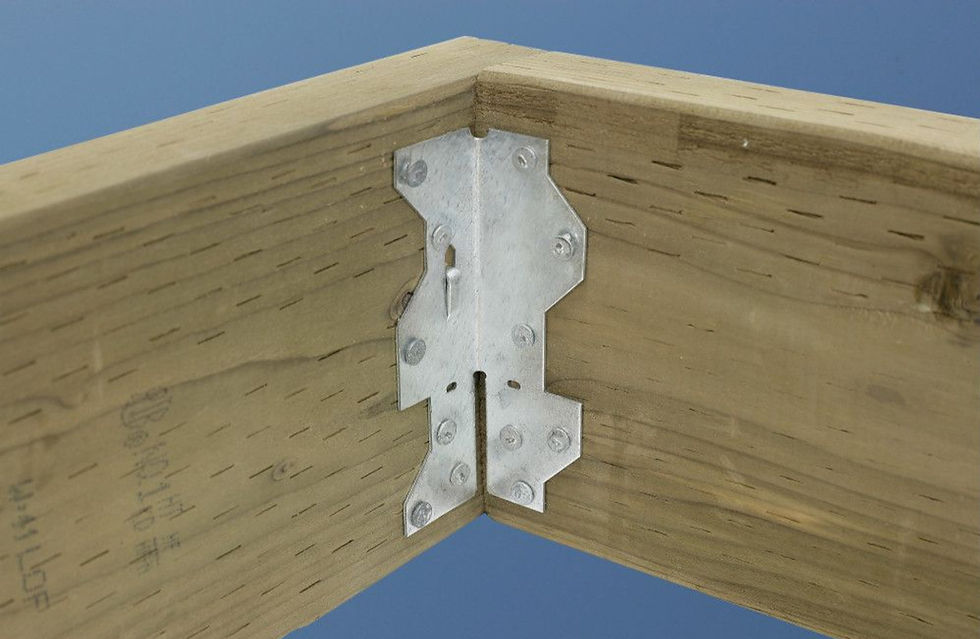
The Myth: “Just smash an A35 flat and boom—it’s an LTP4.”
We’ve all seen it: someone flattens or “butterflies” an A35 framing angle to fake a twist strap like LTP4. It looks clever… until you check capacity, code, and liability.
Short version: don’t do it. The A35 and LTP4 are different parts, with different geometry, test basis, fastener schedules, and intended load paths. You can’t bend or re-form a listed connector and expect any published performance to still apply.
Why “A35 → LTP4” Is a Bad Idea (Mechanics + Code)
1) Geometry & load path ≠ the same
A35 is a small angle that shines in shear transfer at 90°.
LTP4/LTP5 are twist straps meant to carry tension across planes (out-of-plane load paths), with a long, continuous strap length to develop force. Flattening an angle chops the effec
tive leg geometry and creates unintended prying and eccentricity you won’t see in the strap’s test data.
2) You’ve voided the listing and any tested values
Manufacturer capacities are based on specific shapes, hole patterns, steel thickness, and bend radii—then verified with cyclic and monotonic tests. Once you re-bend the steel:
Hole spacing changes relative to edges and end distances.
Local yielding and micro-cracking at the bend reduce capacity.
The galvanized coating gets fractured at the “homemade” bend.Bottom line: No ICC-ES / code-recognized table covers your modified part. If anything fails, that’s on you.
3) Code wants positive, mechanical connections—as designed
For seismic/wind anchorage, standards require positive, mechanical (or welded) connections with continuous ties into diaphragms—not toenails and not improvised hardware.
4) Sheathing ≠ tension tie (and straps/anchors must carry it)
Wood sheathing is great for in-plane shear, but not for direct tension/compression tie forces. Anchorage forces from walls/roofs need to go into framing members via straps or anchors, then across the diaphragm via continuity ties/sub-diaphragms—that’s literally why strap hardware exists.
A35 vs. LTP4: What Each Part Is Actually For
A35 Framing Angle
Use for: Stud-to-plate, blocking, small shear transfer at right angles, light hold-downs where angle action applies.
Advantages: Pre-punched pattern, fast install, great “universal” clip for wood-to-wood corners.
LTP4 / LTP5 Twist Straps
Use for: Tension ties across misaligned members (e.g., rafter-to-top-plate, truss heel), or when one member sits out of plane from another.
Advantages: Proper strap length to develop tension, twist to align planes, rated nail schedules for uplift/out-of-plane actions.
Rule of thumb:
Need shear at 90° between two faces? → Use angles (A35, A34, A66, LS series).
Need tension and out-of-plane continuity? → Use straps (LTP4/5, LSTA/MSTA series, HTT/HTT4 for big tension).
“But I Only Have A35s in the Truck…” (Why the hack still fails)
Strength math doesn’t care about your inventory. That flattened A35 has no published allowable in strap action.
Nail edge-distance and spacing end up wrong once you re-form the part.
Inspector red flag: Modified connectors are non-compliant and often get red-tagged.
Liability: If it pulls apart in a wind event or quake, you just “engineered” it.
Rated Alternatives (Use These Instead)
Light to Moderate Tension/Uplift
LTP4 / LTP5 twist straps
Go-to for small tension paths at rafter heels, truss seats, or misaligned members.
Choose the published nail schedule that matches your demand and species.
H2.5A / H1 “hurricane ties”
Rafter/truss to top plate connections where the members align or nearly align.
Faster than straps when geometry cooperates.
Medium to Higher Tension
LSTA / MSTA strap ties (12/18/24 lengths)
Straight straps for collector/drag or hold-down-lite applications.
Keep full-length embed of nails—don’t “clip short” just to dodge fascia or drywall.
HTT / HTT4 tension ties
When you truly need big uplift values, use a dedicated tension tie with the right embedment/washer/bolt stack.
Shear & Angle Work (not tension straps)
A35 / A34 (angles)
Small shear, blocking, miscellaneous tying.
A66 / HGA10 / LS series (adjustables)
Larger shear at corners, skewed conditions, or when you need more meat than an A35 provides.
Pro hack (the legal kind): If layout is fussy, use LS adjustable angles or LSSU adjustable hangers rather than “field inventing” a strap from an angle.
Fasteners: The Capacity Lives Here
Use the exact nail or screw the table calls for (e.g., 8d common vs. #9 structural screw).
Fill the pattern that matches the table value you’re claiming. Leaving holes empty ≠ “partial credit.”
Watch grain orientation—fasteners in end grain don’t buy you the same resistance.
Don’t stack washers/shims under straps; it changes load paths.
Detailing that Keeps Inspectors Happy
Provide a continuous tie path into the diaphragm—straps/anchors into purlins/collectors, then across with sub-diaphragms/continuity ties (not just sheathing).
Avoid toenails for out-of-plane anchorage. Use positive mechanical connectors.
Remember: Sheathing = shear, straps/angles = direct tie forces.
Field Scenarios (What to Pull from the Bin)
1) Truss heel uplift at exterior wall
Good: LTP4/5 or H2.5A (check geometry), correct nail schedule into truss and top plate.
Not good: Flattened A35 pretending to be a strap.
2) Collector tie across a roof diaphragm break
Good: LSTA/MSTA with full nail fill and proper splice/overlap if required.
Not good: Short scraps or “angle-converted” straps.
3) Stud-to-sill anti-racking at garage return
Good: A35 or A66 angles at corners + proper sheathing nailing pattern.
Not good: An LTP trying to work as an angle (wrong action).
Visuals to Include (helpful for crews & AHJs)
Close-up: “A35 framing angle tying stud to plate—shear path at 90°.”
Installed strap: “LTP4 across rafter heel to top plate—tension path out of plane.”
Do/Don’t diagram: “Continuous tie path with straps vs. failed path using toenails/modified parts.”
Spec arrows: Callouts for nail type, edge distance, and hole fill.
Quick FAQ
Q: Can I clip holes off a strap to dodge an obstruction? A: If you remove holes/length, you’re no longer matching a published table. Use the next-shorter listed part or reroute.
Q: The load is small—why can’t I improvise? A: Because capacity and ductility come from tested, listed configurations. “Small” loads grow with load combos and events you can’t predict.
Q: The inspector said no toenails for wall anchorage. Why? A: Codes require positive mechanical connections and ties into the diaphragm for out-of-plane forces—toenails are withdrawal-limited and not an acceptable substitute.
Bottom Line
Don’t smash an A35 into an LTP4. Different part, different job.
Pick a connector that matches the load path: angles for shear, straps/ties for tension, hurricane ties for rafter/truss anchorage, tension ties for big uplift.
Install with the listed fasteners and full patterns you’re claiming.
Detail the continuous ties and collectors the code expects.
Comments